
CELEBRITY
JUST IN: Minnesota judge orders acting director of ICE to appear in federal court and explain why he should not be held in contempt for violating court orders. Follow live updates:

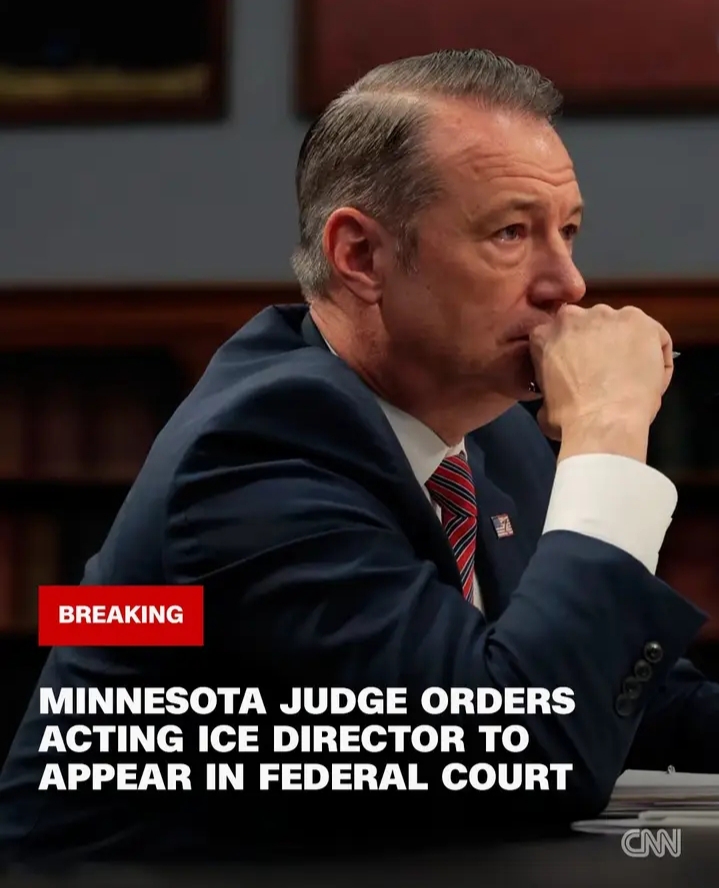
Minnesota judge orders acting director of ICE to appear in federal court and explain why he should not be held in contempt for violating court orders.
Follow live updates:
Minnesota Federal Judge Orders Acting ICE Director to Appear in Court, Warns of Contempt
A federal judge in Minnesota has taken the rare step of ordering the acting director of U.S. Immigration and Customs Enforcement (ICE) to appear in his courtroom and explain why he should not be held in contempt for failing to follow judicial orders.
In a sharply worded order issued late Monday, **Chief U.S. District Judge Patrick J. Schiltz**, a George W. Bush appointee, demanded that **ICE’s acting director, Todd Lyons**, personally appear in federal court in Minneapolis this Friday to “show cause” why he should not be held in contempt of court. Schiltz said the agency had repeatedly failed to comply with court directives in immigration cases, including an order to provide a detained immigrant with a bond hearing within a set timeframe or release him.
Schiltz wrote that the court’s “patience is at an end,” saying ICE had ignored **dozens of orders** across multiple federal cases in Minnesota, causing “significant hardship” for immigrants who have been held in custody longer than judges permitted or moved to distant detention facilities contrary to court rulings.
The contempt threat stems from *Operation Metro Surge* — a major immigration enforcement initiative in the Twin Cities — which has generated a surge of habeas corpus petitions and civil rights lawsuits from detainees claiming unlawful detention. Federal courts have consistently found in favor of immigrants in many of these cases.
Federal law enforcement and the Department of Homeland Security have pushed back, with DHS officials labeling the judge’s actions as judicial overreach and defending ICE’s enforcement work. However, Schiltz’s order underscores increasing tension between the federal judiciary and the executive branch over how aggressive immigration operations are carried out and whether they adhere to constitutional protections such as due process.
Lawyers for detainees and civil rights advocates have welcomed the judge’s intervention as a necessary check on government power, while critics warn the dispute could deepen political and legal gridlock over immigration enforcement policy. Observers say having the acting head of a major federal agency summoned to explain alleged contempt of court is an unusual and consequential moment in the broader legal battle over U.S. immigration enforcement.

JUST IN: Janet Correa, who previously went viral after singing the pro-Trump “Vote Trump” anthem at a MAGA rally, is now speaking out in anguish after her husband was reportedly detained by ICE in Miami. According to immigration attorneys familiar with the case, he has been placed under expedited removal, a fast-track deportation process that allows little time for legal appeals.

Former President Joe Biden criticized the Trump administration over the fatal shootings of Alex Pretti and Renee Good by federal agents in Minneapolis in a post on X on Tuesday. Biden called for investigations into the deaths of Pretti and Good, and said he and former first lady Jill Biden are “sending strength” to their families and communities. He also called on Americans to “stand up and speak out” against the administration in light of its actions in Minnesota.

The Court’s patience is at an end.” The chief judge in Minnesota has ordered Acting ICE Director Todd Lyons to appear in court in person on Friday to answer to why the agency has not complied to the dozens of orders that Minneapolis courts have filed. Chief Judge Patrick Schiltz wrote, “Accordingly, the Court will order Todd Lyons, the Acting Director of ICE, to appear personally before the Court and show cause why he should not be held in contempt of Court.”

JUST IN: A woman who says she is an Epstein victim has claimed there are TAPES of Donald Trump that will FORCIBLY end his presidency. She alleges these recordings, if released, contain PROOF of misconduct so serious that Trump would have no choice but to RESIGN. The claim is UNVERIFIED for now, but it has already triggered a FIRESTORM in Washington and among Trump’s allies and critics.

JUST IN: Minnesota judge orders acting director of ICE to appear in federal court and explain why he should not be held in contempt for violating court orders. Follow live updates:

JUST IN: The family of Alex Pretti, the ICU nurse shot and killed by federal agents in Minnesota, have hired lawyer Steve Schleicher. He is best known for helping secure the murder conviction of former police officer Derek Chauvin in the killing of George Floyd.

BREAKING: President Trump has filed a $10 billion lawsuit against the IRS, accusing the agency of leaking his tax returns and other confidential information involving him, his family, and the Trump Organization to media outlets. The suit claims the disclosures were illegal and harmed millions by violating federal privacy laws.

JUST IN: A new investigation reveals that the Trump family could face STATE charges and potentially go to JAIL for allegedly profiting off the presidency. Prosecutors in MULTIPLE states are building cases focused on business deals, tax schemes, and misuse of office tied to the White House years. This raises the stakes in 2026, with the possibility of criminal convictions and prison time for Donald Trump and close family members

A top federal court judge has criticized the US Immigration and Customs Enforcement (ICE) agency for violating almost 100 court orders over the past month. In a new court filing, US District Court Chief Judge Patrick Schiltz wrote:

BREAKING: After Pam Bondi requested Minnesota’s voter data, MN officials reportedly sent her exactly 1% of their records with it all blacked out and a note on the top of every page that says, “Most transparent state government ever.”

BREAKING: The White House is in full blown panic mode right now. Kristi Noem is throwing Stephen Miller under the bus, Miller is throwing Greg Bovino under the bus, Republican senators are calling for Noem to be fired…
