
CELEBRITY
JUST IN: Congress Blocks Donald Trump’s SAVE Act Move, Stalling Proposed Federal Voter Eligibility Overhaul After Fierce Debate Over Voting Rights and Constitutional Limits Full details ⤵️

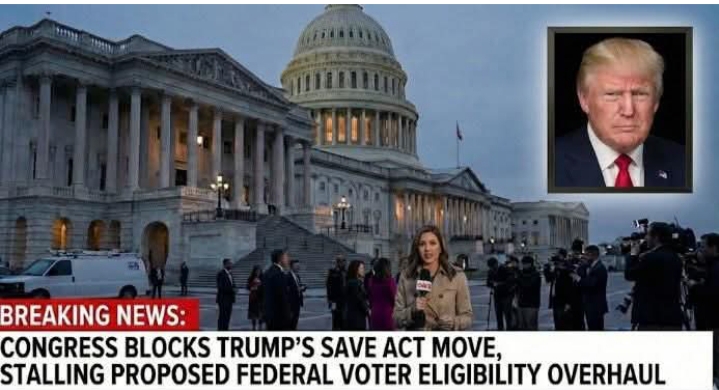
JUST IN: Congress Blocks Donald Trump’s SAVE Act Move, Stalling Proposed Federal Voter Eligibility Overhaul After Fierce Debate Over Voting Rights and Constitutional Limits
Full details ⤵️
## **JUST IN: Congress Blocks Trump’s SAVE Act Push — Federal Voter Eligibility Overhaul Stalled After Heated Battle**
In a dramatic turn on Capitol Hill, Congress has **blocked efforts to advance the Trump-backed Safeguard American Voter Eligibility (SAVE) Act**, a high-profile federal voting overhaul that has become a flashpoint in the broader debate over voting rights and constitutional limits. The move effectively **stalls the proposed overhaul** of federal voter eligibility requirements that former President Donald Trump and allied lawmakers had been pushing hard to enact.
### **What the SAVE Act Would Have Done**
The **SAVE Act (H.R. 22)** — formally titled the *Safeguard American Voter Eligibility Act* — sought to amend the 1993 National Voter Registration Act by requiring **documentary proof of U.S. citizenship** to register for federal elections, such as a passport or other government-issued credentials. It also included provisions to compel states to remove noncitizens from voter rolls and imposed penalties on officials who register individuals without such documentation. Supporters argued this would tighten election integrity, particularly around noncitizen voting.
### **Why Congress Stalled the Proposal**
After passing the Republican-led House, the measure was **blocked from moving forward in the Senate**, where it failed to secure the necessary support for debate and advancement, effectively **halting the legislation**. Republicans had hoped to push it through alongside appropriations and other legislative priorities, but Democratic opposition — and resistance from some Republicans concerned about federal overreach — proved decisive.
The stalled effort reflects deep disagreements over election law and constitutional authority. Opponents argued the SAVE Act would **disenfranchise millions of eligible voters** — particularly those without ready access to the required documentation, such as low-income citizens, older Americans, and naturalized voters — and represented an unprecedented federal intrusion into election administration traditionally handled by states.
### **Contentious Debate Over Voting Rights and Federal Power**
The debate around the SAVE Act has become emblematic of wider partisan and legal clashes over voting rights. Supporters, including Trump and many House Republicans, have championed the bill as a necessary step to secure elections and prevent illegal voting. Critics, including Democratic lawmakers and civic groups, condemned it as a form of voter suppression and an unnecessary barrier to democratic participation.
Some Republicans also broke ranks, warning that the measure risks unconstitutional **federal overreach** into areas traditionally governed by state election law.
### **What’s Next**
With the SAVE Act now stalled, the broader national conversation on voting rights is likely to persist. Democrats may use this legislative moment to push alternative reforms aimed at expanding access to the ballot, while Republicans could try reviving similar proposals in future sessions. Meanwhile, legal battles around other federal voting initiatives continue to echo in courts and in political discourse.

Today, AOC was asked what she thought about Trump saying he couldn’t understand Bad Bunny. She replied, ‘I barely understand what Trump’s saying half the time, so I feel him.’

BREAKING: “You washed-up loser lawyer!” Pam Bondi throws a FURIOUS tantrum after Rep. Jerry Nadler confronts her on letting Epstein’s cronies walk free! READ MORE .👇👇👇👇

BREAKING: Top Republicans are reportedly complaining that, if the American people demanded the resignation of everyone involved in the cover up of the Epstein Files, the Trump Administration would have “like 3 people left.”

JUST IN: TRUMP Could Be JAILED TODAY — Judge Just Drew the Line He Can’t Cross

BREAKING EXCLUSIVE: House Democrats are just TWO votes short of impeaching President Trump before March 31, sources say, over explosive allegations of an Epstein COVER-UP. With momentum building in key committees, the push centers on claims Trump shielded the late financier from scrutiny during his first term. This high-stakes move could SHATTER Republican defenses if two GOP members flip, thrusting Washington into CHAOS ahead of critical deadlines. Stay tuned as votes align in this URGENT political showdown.

I wish this were just a joke, but it’s not. U.S. Senator John Kenn3dy is now publicly demanding that Barack O.b.a.m.a return $120 million that he allegedly earned through ownership related to “Obamacare.”

🚨Trump PANICS as Epstein Names EXPOSED⚡….. Two members of Congress — Republican Thomas Massie and Democrat Ro Khanna — say they discovered that the DOJ and FBI had redacted the names of six powerful men from the Epstein files. After they raised concerns, the DOJ admitted the redactions were a “mistake” and revealed the names:

TRUMP PUSHES $20B SUB DEAL — CANADA SAYS NO, WASHINGTON STUNNED ⚡ What was supposed to be a pressure win reportedly blew up fast. U.S. officials expected Canada to fold on a massive submarine push — instead, Ottawa flatly refused.

JUST IN: Congress Blocks Donald Trump’s SAVE Act Move, Stalling Proposed Federal Voter Eligibility Overhaul After Fierce Debate Over Voting Rights and Constitutional Limits Full details ⤵️

JUST IN: Political fallout spreads across Europe as new Epstein documents trigger high-profile resignations. Officials from Norway to Slovakia have stepped down amid revelations of alleged ties to the convicted sex offender.

ONE MILLION VOICES RISING — TRUMP IMPEACHMENT PETITION EXPLODES ONLINE A new petition tied to Trump impeachment discussions is reportedly racing toward 1 MILLION signatures, showing just how fired-up and divided Americans are right now. Supporters call it a powerful demand for accountability, while critics warn it could ignite even deeper political chaos. Is this the turning point that forces Congress to act—or just another digital storm?
